
The morning began, like countless others, with what seemed like a simple journal entry. I was wrestling with the same questions that have followed me since retirement: what I still hoped to accomplish, what purpose looked like after a career, and whether I had spent too much of my life asking, What’s next? instead of learning to simply be.
The thoughts were undoubtedly a continuation of my last essay, On Becoming. That topic has been on my mind a lot recently. Perhaps it has something to do with approaching the five-year mark since the end of my career. Or perhaps it’s the string of doctor’s appointments that have me thinking more about the future. Not because it looks bleak. Other than my vision, every indication is that I am healthy.
After breakfast, I took Skye for a walk around the neighborhood. Marilyn and I are preparing to attend a music festival in Montana, and I was listening to one of the artists who will be performing, Jamestown Revival. We’d seen them years ago at the Telluride Blues and Brews Festival and really enjoyed their music.
As Skye sniffed around the bushes, one of their songs came on, Young Man. A haunting, soulful sound that caught my attention. Then I heard the lyrics.
I walked back down the river bend road
Gathered up a couple good stones
Down to the water, went looking for a load
Wasn’t very far from home
I saw my face at the water’s edge
A man with the heavy heart
But every now and then he feels so close
But every now and then so far
Tell me, where did the young man go
I love lyrics that make me stop and think. Those did.
Not so much because they were about growing older, but because they reminded me what I love about music. Its power to make us feel something.
I love music with moving blues guitar riffs, haunting saxophone solos, or soulful harmonies. I’ve spent much of my life listening to music, sometimes even singing along with the lyrics, with little sense of what they mean. Yet somehow, their meaning still finds its way in.
One of my favorite R&B songs is by the Cornelius Brothers & Sister Rose, It’s Too Late to Turn Back Now.
It’s too late to turn back now
I believe, I believe, I believe I’m falling in love
It’s too late to turn back now
I believe, I believe, I believe I’m falling in love
I found myself phoning her
At least ten times a day
It’s hard not to smile as you listen.
It’s the story of a man, surprised to realize he is falling in love.
Then, after the bridge.
I wouldn’t mind it
If I knew she loved me too
But I hate to think that I’m in love alone
And there’s nothing that I can do
Just a handful of words. Less than fifteen seconds. And suddenly everything feels different.
It’s Too Late to Turn Back Now.
Once you understand their meaning, your experience changes.
The music that had sounded hopeful now feels sad. Sorrowful. Yet the notes haven’t changed. The melody hasn’t changed.
Only you have.
It strikes me as an interesting metaphor for life. We don’t simply experience the world. We experience the meaning we give it.
Words have the power to shape perception.
“I’m retired.”
“My career is over.”
“I’m beginning my second act.”
Each describes the same circumstance, yet each tells a different story. The facts don’t change. The feeling does.
As I look back at that journal entry, I hear the words differently. What I thought was a question about retirement now feels like a much deeper question: How do I give my life meaning?
It reminded me of Viktor Frankl’s Man’s Search for Meaning. Frankl explored that question under circumstances I can scarcely imagine. My circumstances are very different, yet the search for meaning seems to be a uniquely human experience.
For many of us, there comes a point when the milestones we’ve spent a lifetime chasing are largely behind us. The promotions have been earned. The children are grown. Retirement arrives. And we find ourselves facing a quiet existential question:
Did my life matter?
In the end, no one else can answer that question for us. Only we can.
Looking back, I realized what those two songs had been teaching me. One was about growing older. The other was about the pain of an unrequited love. But beneath both was a more subtle lesson about meaning.
A melody can stir our emotions, but it’s often the lyrics that change our understanding. A handful of words can transform a song from hopeful to heartbreaking, from nostalgic to triumphant. The notes never change. We do.
It seems to me that life works the same way.
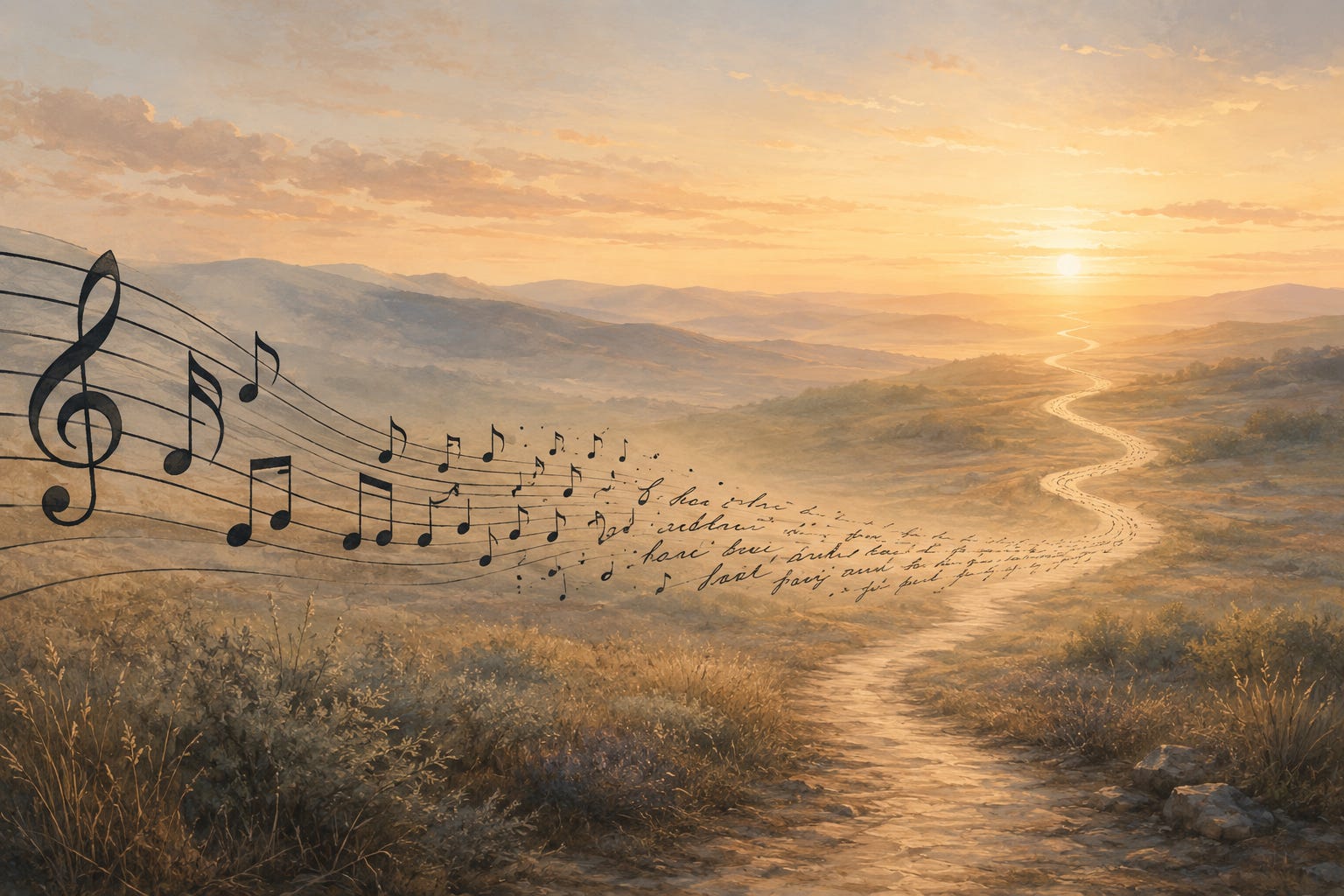
The events of our lives are the melody. The words we use to describe those events give them meaning.
Is failure the end of a dream, or the beginning of a different one?
Is growing older the beginning of the end, or simply the end of the beginning?
The words are almost the same.
The meaning isn’t.
Those words become the lyrics that shape how we experience everything that follows.
I began that morning wondering what I still wanted to accomplish. I ended it wondering whether accomplishment had ever really been the point.
For most of my life, I assumed a meaningful life was something you built through achievement. Maybe that’s why learning to “just be” has always felt so difficult. If meaning comes only from accomplishment, then how can simply being ever feel like enough?
That’s the real lesson hidden in a simple journal entry, a walk with my dog, and two songs.
The words we choose matter. They become the stories we tell ourselves.
The meaning we assign to our lives becomes the life we experience.