
In my last essay, The Lyrics of Our Lives, I wrote about attending the Under the Big Sky Music Festival in Whitefish, Montana. One of the highlights was hearing Jamestown Revival open their set with Young Man, the song that inspired that piece.
If you’ve never been to Montana, it’s worth the trip. The five-hour drive from Bozeman to Whitefish alone is reason enough to go. Rolling hills, green mountains, crystal-clear lakes, and an endless sky create a landscape that somehow feels both expansive and peaceful. I love Colorado and have no desire to leave it, but if I ever did, Montana would be near the top of my list.
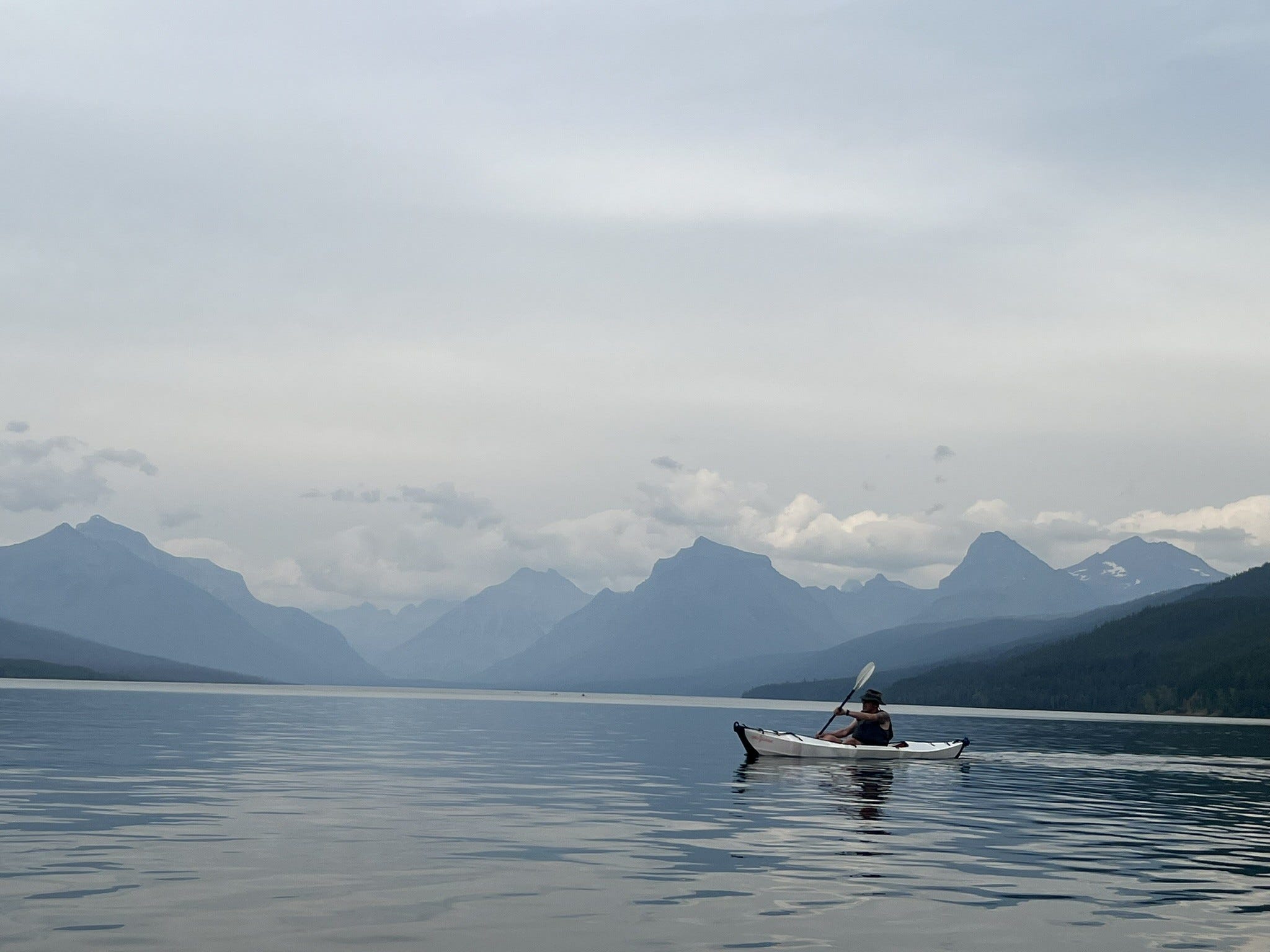
After the festival, we spent a couple of days exploring Glacier National Park. We didn’t have nearly enough time to experience everything the park has to offer, but kayaking on Lake McDonald and Bowman Lake became two of the highlights of our trip. There is something about being surrounded by mountains and still water that naturally quiets the mind.
The drive home was an entirely different experience. We headed south through Idaho Falls and then crossed nearly 180 miles of western Wyoming. Gone were the forests and lakes. In their place was an immense, open landscape stretching to every horizon, with scarcely a tree or even a bush to interrupt it. At first glance it seemed almost barren. Yet the farther we drove, the more I appreciated its beauty.
Montana invited me to admire what surrounded me. Wyoming invited me simply to notice the space.
A friend had recently recommended Inner Cosmos, David Eagleman’s neuroscience podcast. As I sat watching the road snake through mile after mile of vast openness, I found myself scrolling through the episodes.
One title immediately caught my attention: Do You Really Have a Self?
As miles of open country rolled past the windshield, the conversation seemed strangely appropriate. The landscape had become uncluttered. The podcast was asking me to consider how cluttered my own mind had become.
What if the person I spend my life defending, judging, and worrying about isn’t quite what I think it is?
It is a bizarre idea to wrap your mind around.
I know who I am.
Or at least I feel certain that I do.
That certainty feels essential because not knowing who we are would be profoundly destabilizing. So we cling to an image of ourselves. We defend it. We build our lives around it. We rarely stop to question whether it is as solid as it feels.
Then Harris offered an example that gave me my first real glimpse of what he was describing.
We can sit in a movie theater while the camera slowly zooms in until an actor’s face fills the entire screen, their eyes seemingly staring straight at us, and we barely notice. Yet let a stranger in a coffee shop look directly into our eyes for more than a few seconds, and the experience feels completely different.
What changed?
If the experience were only about what our eyes were seeing, the movie should feel more intimate, more invasive. But it doesn’t. The discomfort isn’t in the image itself. It arises the moment we experience being seen.
A moment earlier, you were reading a book with a cup of coffee in your hand. Then your eyes meet a stranger’s. Instantly, you are no longer just observing the world.
You are in the story.
As I’ve been working on my novel, one thing has become increasingly clear to me: believable characters have depth. They have strengths and flaws. They carry fears, insecurities, desires, and hopes. They have a history that explains why they respond the way they do.
So, in that coffee shop, when we are suddenly pulled into even the briefest relationship with another person, our minds don’t simply notice them. They instantly begin writing a story. And just as quickly, they cast us as one of its characters.
Without realizing it, we begin playing the part.
If our minds are constantly writing stories, it raises an uncomfortable question: What story has my mind been writing about me?
For years, I never questioned that the voice in my head was telling me the truth.
That story, all too often, had a central theme. I wasn’t smart enough. Aggressive enough. Strong enough. It was a long list.
Then I started losing my central vision, and that story found new material. The distance between who I thought I should be and who I was grew even wider.
I could no longer fly a plane. Ride a motorcycle. Ski. Drive a car. Read a book.
My mind kept returning to the same refrain: I can’t....
But somewhere along the way, almost without noticing, the story began to change. I found myself thinking less about what I had lost and more about all that I had.
I may never ride a motorcycle again, but I am writing my second book. I may never ski another black diamond, but I just paddled Bowman Lake in Glacier National Park.
So, do we have a self? An unchanging, immutable me?
As I look back over the past sixty-seven years, I don’t see the same person I was fifteen years ago. Or thirty. My life has unfolded in countless seasons, each with a different version of me walking through it.
Good ones.
Extraordinary ones.
Others I still struggle to talk about.
Each season of my life was real. For years, I accepted the stories my mind told me about who I was as facts. It wasn’t until I began questioning those stories that my life changed. My world became larger. I began to see possibilities where I had only seen limitations.
Not everything has worked out the way I hoped. Some days I still look in the mirror and don’t like the person looking back. But if I stay with that feeling long enough, I remember something important.
I may be a character in the story my mind is telling.
But I am also the author.